


Your family land has a story.
For many families, land isn’t just an asset — it’s history.
It’s where memories were made, where hard work paid off, and where legacy took root.
When the time comes to sell, the decision isn’t just financial.
It’s emotional.
What happens next matters.
More Than Dirt
Selling land is not just a transaction.
It is a decision that can shape what comes next for your family, your income, and your legacy.
TELEIOS Financial is based in Celina, Texas, and works to educate landowners, farm and ranch families, business owners, and investors who are preparing for the sale of land, family property, farmland, ranch land, or investment real estate — helping them understand what options may be available before the sale closes.
For families with property here in Texas or family land tied to a broader story elsewhere, the planning conversation should begin before the sale is final.
A 1031 exchange, Delaware Statutory Trust (DST), or other tax-aware planning conversation may create more options — but only when the right professionals are involved before closing.
Our role is to help educate, organize, and coordinate the financial planning side of the conversation alongside tax advisors, attorneys, and Qualified Intermediaries.
Before the Dirt Changes Hands
When family land is involved, the sale is rarely just a transaction.
It can affect income, taxes, heirs, legacy, and how the next generation receives what was built before them.
That is why land-sale planning should start before closing — while options are still available.
Our role is to help landowners understand what options may be available, coordinate with the right professionals, and think through how today’s sale may affect the family’s next chapter.
Change Your Outcome Before You Close.
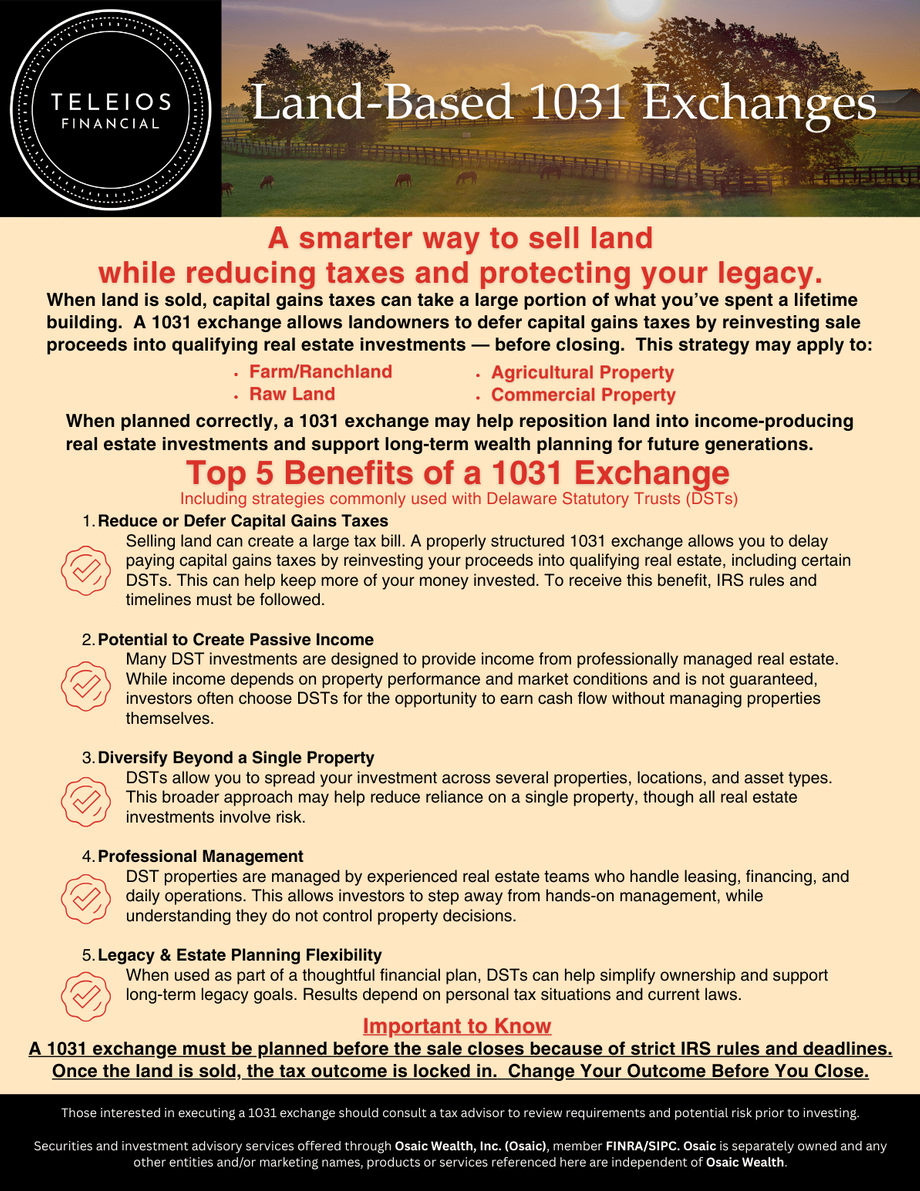
When land or investment property is sold, capital gains taxes can take a large portion of what you’ve built.
A properly structured 1031 exchange allows you to defer those taxes by reinvesting into qualifying real estate — but it must be planned before the sale closes. It’s important to work with qualified professionals on each aspect of a 1031 exchange – tax advisors, a qualified intermediary attorney, and a financial professional – before you close on your sale.1
A 1031 exchange involves many moving parts and many implications for your tax and financial situation. Once you close, the tax outcome is locked in, so prior planning is essential.
The 1031 Clock
5 Critical Steps
Step 1 — Decide Before Closing
You must elect to pursue a 1031 exchange before the sale closes.
If you wait until after closing, it’s too late. There is no “undo” button.
Step 2 — Hire a Qualified Intermediary (QI)
A Qualified Intermediary must be engaged before closing.
They prepare the exchange documents and hold the sale proceeds. You cannot take possession of the funds.
We can introduce you to experienced Qualified Intermediaries and help coordinate the process.
Step 3 — Property Closes (Two Important Clocks Start)
The day your property closes is Day 0.
• The 45-day identification clock
• The 180-day completion clock
Step 4 — 45 Days to Identify Replacement Property
You have 45 days to identify potential replacement properties in writing.
Miss that deadline — the exchange fails.
Step 5 — 180 Days to Complete the Purchase
You have 180 days from the original closing date to complete the purchase of your replacement property.
If the purchase is not completed in time, the exchange is disqualified.
Why It Matters
• Defer capital gains taxes
• Reposition land into income-producing property
• Diversify beyond a single asset
• Transition from active management to passive ownership
It’s won before closing — through planning and coordination.
Understanding the Role of a DST
A Delaware Statutory Trust (DST) is a strategy available to accredited investors for completing a 1031 exchange — often moving from actively managing land into professionally managed real estate.2
If you’re considering selling land, this is worth understanding before you close.
Below is a simple breakdown of how a DST works within a 1031 strategy.
Let’s Preserve Your Legacy
Selling land doesn’t mean giving up what it represents.
With the right planning, it can mean continuing the story — just in a different form.
Your family’s land has a story. Let’s preserve your legacy.
Disclosures
1: This is not an offer for, or solicitation of, any security. 1031 exchanges are complex processes and are highly dependent on your individual situation. Consult a tax advisor to discuss the tax consequences of a 1031 exchange.
2: The Securities and Exchange Commission (SEC) defines an “accredited investor” as an investor that meets any of the following criteria: a natural person with a net worth over $1 million, excluding primary residence (individually or with spouse or partner); an income over $200,000 individually or $300,000 with a spouse or partner in each of the prior two years and reasonably expects the same in the current year; an entity with assets in excess of $5 million; or corporations, partnerships, LLCs, trusts, 501(c)(3) organizations, employee benefit plans, “family office” and any “family client” of that office with assets in excess of $5 million.